


7 Garage Door Safety Features You Need in 2026
What Safety Features Should a Garage Door Have?
Every garage door should have features that protect people, pets, and property. The ANSI/CAN/UL 325 standard, which applies to both Canada and the United States, sets the minimum safety requirements for garage door operators and systems. It covers entrapment protection, sensor requirements, and operator functionality.
If your garage door opener was installed before 1993, it likely does not meet current safety standards. The good news is that upgrading does not always mean replacing the entire door. In many cases, adding or updating specific features can bring your system up to standard.
Here are seven garage door safety features every homeowner, business operator, and property manager should have in 2026.
1. Auto-Reverse System
This is the most important safety feature on any garage door. The auto-reverse system detects when something is in the path of a closing door. It stops the door and reverses direction immediately.
There are two parts to this system.
- The first is a mechanical sensor built into the opener motor. It detects resistance when the door hits a solid object.
- The second is an infrared photo-eye sensor mounted on each side of the door frame, about six inches off the ground.
These sensors create an invisible beam across the opening. If anything breaks that beam while the door is closing, the door stops and reverses.
Under UL 325, both the mechanical reverse and the photo-eye sensors have been required on all residential garage door openers sold in Canada and the U.S. since 1993.
How to test it: Place a 2×4 flat on the ground where the door closes. Press the close button. The door should reverse within two seconds of touching the board. You should test this monthly.
2. Photoelectric (Infrared) Sensors
These are the small black boxes mounted on either side of your garage door tracks, near the floor. They send an invisible infrared beam across the opening. If a child, pet, or object crosses that beam while the door is closing, it stops immediately.
Dirt, cobwebs, and minor bumps can knock them out of alignment. When that happens, the door may not close at all. Or worse, it may close without detecting an obstruction.
Maintenance tip: Clean the sensor lenses with a dry cloth every few months. If one LED light is red instead of green, the sensors are misaligned.
3. Manual Release Handle
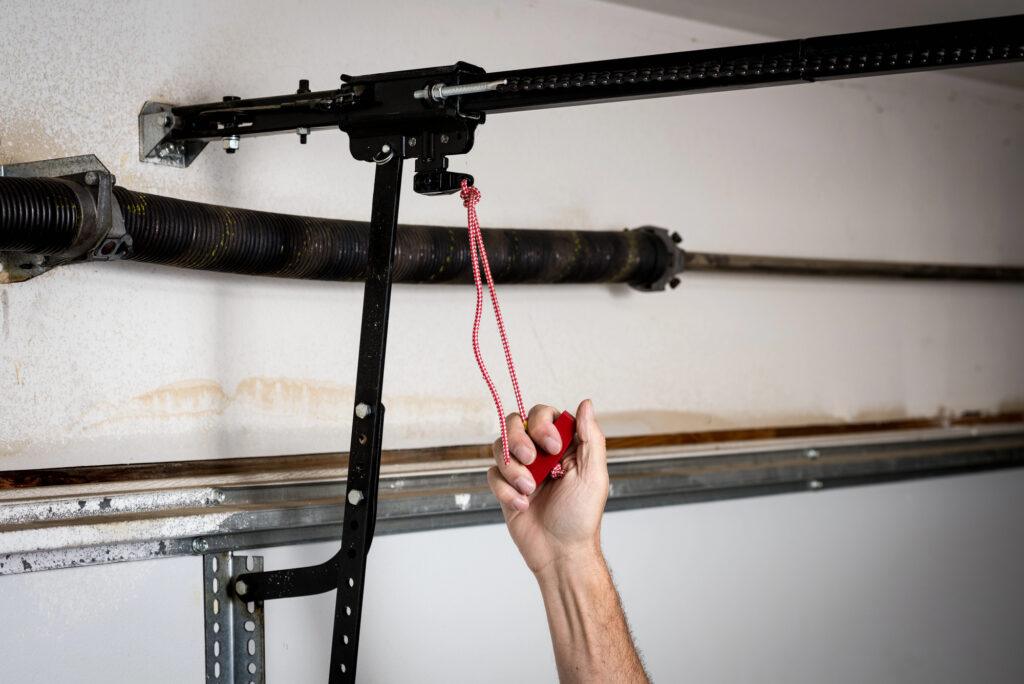
Every automatic garage door opener comes with a manual release. It is usually a red cord hanging from the opener rail. Pulling it disconnects the door from the motor, allowing you to operate it by hand.
This matters during power outages, mechanical failures, or emergencies. Make sure every adult in your household knows where it is and how to use it. Stewart Overhead Door has a detailed guide on how to use and reset a garage door emergency release.
4. Rolling Code Technology
Older garage door openers used a fixed radio code. Every time you pressed the remote, it sent the same signal. Someone with a code-grabbing device could copy it and open your door.
Rolling code technology fixes this. Every press generates a new encrypted code. The old one is discarded. This makes it nearly impossible for someone to duplicate your signal.
If your opener is more than 10 to 15 years old, it may still use a fixed code. Stewart Overhead Door carries a full line of residential openers with built-in rolling-code encryption.
5. Battery Backup System
Power outages happen. In southwestern Ontario, ice storms and high winds can knock out electricity for hours or days. Without a battery backup, your garage door is stuck.
Modern openers with battery backup keep working when the power goes out. You can still use your remote, wall button, or smartphone app. This is especially important if your garage is the primary entry point to your home.
6. Smart Garage Door Controls
Smart-enabled openers let you monitor and control your garage door from anywhere using your phone. You can check if the door is open, get alerts when it moves, and close it remotely if you forgot.
A garage door left open overnight is an invitation for theft, animals, or weather damage. Smart controls eliminate that risk. Many openers available through Stewart Overhead Door include built-in Wi-Fi, myQ app compatibility, and integrated cameras.
7. Pinch-Resistant Door Panels
This one is about the door itself, not the opener. Older garage doors have gaps between the panels that can trap fingers as the door opens and closes. This is a serious risk for children.
Modern garage doors are designed with pinch-resistant panels. These use a tongue-and-groove joint that pushes fingers away from the gap as the panels move. If you have young children and an older garage door, this is a feature worth upgrading.
Traditional vs. Modern Garage Doors. How Safety Has Changed
If your garage door system is more than 10 to 15 years old, it may be missing several features that are now standard. Here is how older systems compare to what is available today.
| Feature | Traditional Doors (Pre-2010) | Modern Doors (2020s) | Why It Matters |
|---|---|---|---|
| Obstacle Detection | Mechanical contact reverse only. Door must physically hit an object before reversing. | Dual system: infrared photo-eye sensors plus mechanical reverse. Door stops before contact. | Prevents injuries to children, pets, and property. Required by UL 325 since 1993. |
| Remote Security | Fixed radio code. Same signal every time. Can be copied with a code grabber. | Rolling code encryption. New code generated with every press. Cannot be duplicated. | Stops unauthorized access. Major theft deterrent. |
| Power Outage Access | Manual release handle only. No motorized backup. | Battery backup keeps the opener running for up to 50 cycles during an outage. | You are never locked out. Critical during Ontario ice storms and winter weather. |
| Remote Monitoring | None. No way to check door status without being there. | Smartphone app control with real-time alerts and live camera feeds. | Close the door from anywhere. Get notified if it opens unexpectedly. |
| Panel Design | Flat panels with exposed joints. Gaps between sections can trap fingers. | Pinch-resistant tongue-and-groove panels that push fingers away during movement. | Reduces the risk of finger injuries, especially for children. |
| Lighting | Single bulb on opener unit. Manual switch. | Built-in LED motion-activated lighting. Corner-to-corner coverage on premium models. | Better visibility in the garage. Deters intruders. Reduces trip and fall risk. |
| Insulation | Single-layer steel. No insulation. Poor energy performance. | Double or triple-layer construction with polyurethane foam (up to R-18). | Lower heating costs. Quieter operation. Better durability in Canadian winters. |
If your system is missing more than two of these features, it may be time for an upgrade. Stewart Overhead Door can assess your current setup and recommend the right solution for your home or business.
How Often Should You Test Your Garage Door Safety Features?
Test your auto-reverse and photo-eye sensors every month. A quick test takes less than five minutes.
Beyond that, schedule a professional inspection once a year. A certified technician can check spring tension, cable condition, track alignment, and sensor calibration. Stewart Overhead Door offers planned maintenance services and 24/7 emergency repairs across southwestern Ontario.
What You Should Do Next
Your garage door moves hundreds of pounds multiple times a day. If the safety features are outdated, missing, or not working properly, you are taking an unnecessary risk.
1. Test your current setup. Run the 2×4 auto-reverse test and the photo-eye beam test. Check your manual release handle. If anything fails, do not use the door until it is fixed.
2. Check the age of your opener. If it was installed before 1993, it likely does not meet current UL 325 safety standards. If it is more than 15 years old, it is likely to lack rolling code technology and battery backup.
3. Contact Stewart Overhead Door for a professional assessment. Their certified technicians serve London, Sarnia, Woodstock, Stratford, Chatham, and surrounding communities. Whether you need a repair, an upgrade, or a full replacement, they can help you find the safest and most cost-effective solution.
With more than 60 years of experience across residential, commercial, industrial, and agricultural sectors, Stewart Overhead Door is one of southwestern Ontario’s most trusted names in garage door safety and service.
FAQs
What safety features should a garage door have?
At a minimum, every garage door should have an auto-reverse system, photoelectric sensors, a manual release handle, and rolling code technology on the remote. Battery backup and smart controls are strongly recommended. Pinch-resistant panels add another layer of protection, especially in homes with children. These features are required or recommended under ANSI/CAN/UL 325, which applies in both Canada and the United States.
How do I know if my garage door opener is outdated?
If your opener was installed before 1993, it likely does not have the photo-eye sensors required by current safety standards. If it is more than 10 to 15 years old, it probably uses a fixed code remote, which is a security risk. If it lacks battery backup, you will be locked out during power outages. Stewart Overhead Door can inspect your current system and let you know what needs updating.
How often should I test my garage door safety features?
Test the auto-reverse function and photo-eye sensors every month. Clean the sensor lenses every few months. Schedule a professional inspection at least once a year to check springs, cables, tracks, and overall system health. If anything fails during your home test, stop using the door and call a technician right away.
Are garage door safety upgrades expensive?
It depends on what you need. Adding photo-eye sensors to an older opener is relatively affordable. Replacing a full opener with rolling code technology, battery backup, and smart controls costs more but provides lasting protection. Stewart Overhead Door offers financing through Financeit and can provide a free estimate.