


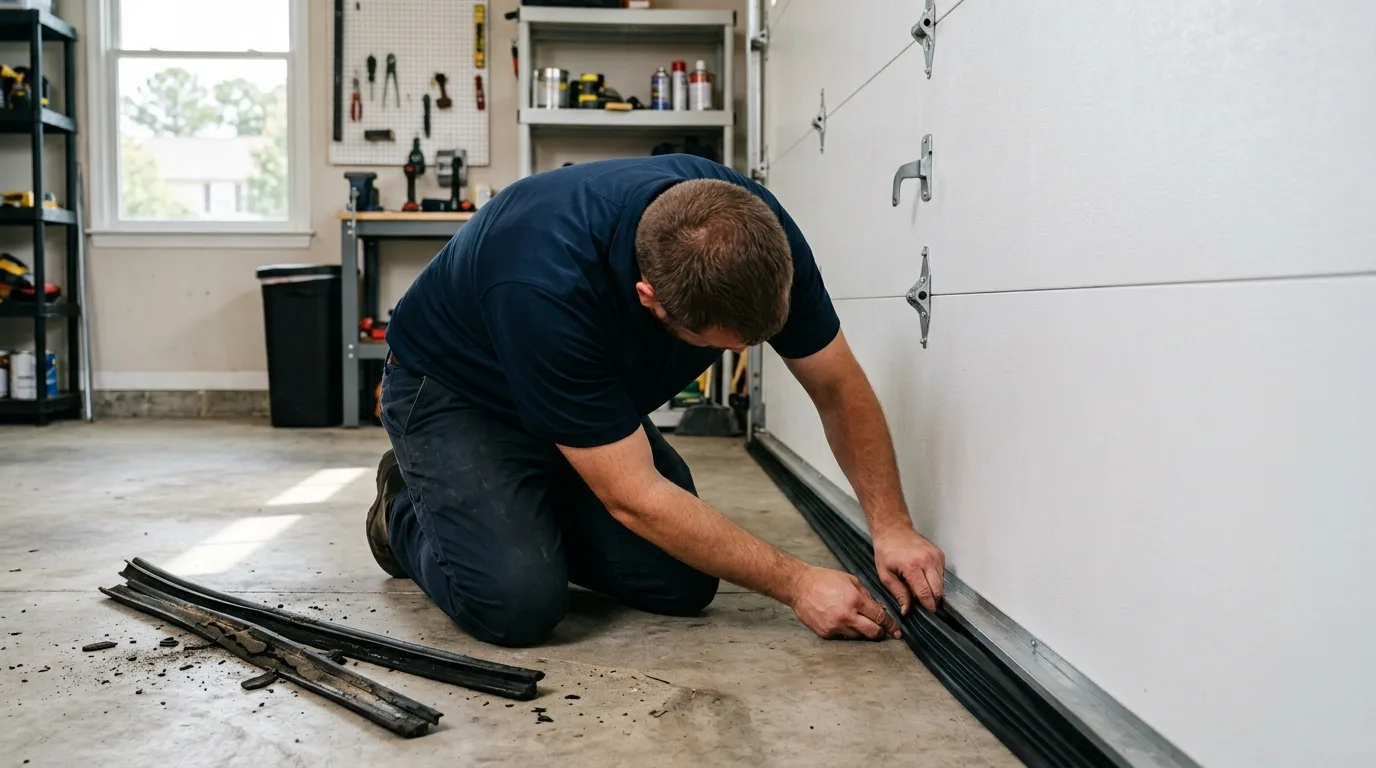
How Often Should You Replace Garage Door Weatherstripping?
Key Takeaways
1. Most garage door bottom seals need replacing every two to five years, while side and top seals often last five to ten, though the real trigger is condition rather than the calendar.
2. Material choice drives most of the difference in lifespan, because EPDM rubber stays flexible through Ontario freeze-thaw cycles while unreinforced vinyl stiffens and splits once the temperature drops.
3. Stewart Overhead Door has been sealing doors across southwestern Ontario since 1964, and our certified technicians can check and replace worn seals during a single planned maintenance visit.
Garage Door Weatherstripping Replacement Intervals in Ontario
There is no fixed manufacturer-recommended interval for garage door weatherstripping replacement, so the honest answer is to replace it when it stops sealing. In practice, that lands most southwestern Ontario homeowners at roughly two to five years for the bottom seal and five to ten years for the seals along the jambs and header.
The bottom seal almost always goes first. It takes the worst of the wear because it gets compressed against concrete on every cycle, sits in meltwater and road salt all winter, and takes direct sun in the summer.
A more useful habit than counting years is inspecting twice a year, once before winter and once after it. Two minutes with the door closed will tell you more than any replacement schedule.
Garage Door Weatherstripping Replacement Timelines by Seal Location
| Seal Location | Typical Replacement Window | What Wears It Out |
|---|---|---|
| Bottom seal (astragal) | 2 to 5 years | Compression on every cycle, meltwater, ice-melt salt, UV exposure |
| Side seals on the jambs | 5 to 10 years | UV, freeze-thaw stiffening, impact from vehicles and equipment |
| Top or header seal | 5 to 10 years | UV and wind-driven rain, less mechanical wear than the bottom |
| Section joint seals | Usually replaced with the door | Panel flex, age hardening, damage during panel repairs |
| Threshold seal on the floor | 3 to 7 years | Tire traffic, snow shovels, plow blades, de-icer chemicals |
Why Southwestern Ontario Winters Shorten Garage Door Seal Life
Rubber and vinyl seals fail faster in a freeze-thaw climate than in a steady cold or mild one. Each cycle from thaw to freeze forces the material to flex while it is at its stiffest, and the seal slowly loses the ability to spring back.
Natural Resources Canada makes this point directly in its Keeping the Heat In guide, noting that some weatherstripping products harden and lose effectiveness in exactly the cold weather when they are needed most.
The guide advises choosing products that are flexible and that spring back to their original shape quickly, which matters because a seal that stays compressed after the door opens is no longer closing the gap.
Ice-melt products add a second problem. Salt and chloride residue collect under the door, stay in contact with the rubber, and accelerate surface breakdown long after the snow is gone.


Six Decades of Garage Door Expertise
Residential, commercial & agricultural door sales, installation & repair.
Garage Door Weatherstripping Types and What Each One Seals
A sectional door carries several different seals, each in a different position and each failing on its own schedule. Knowing which one has gone is what turns a vague draft into a specific, fixable problem.
- Bottom seal. The compressible strip that closes the gap between the bottom rail and the floor. DASMA’s sectional garage door terminology data sheet defines the astragal as a compressible or deformable seal provided on the bottom edge of a door, which is the technical name most suppliers use.
- Side seals. Also called stop molding or jamb seal, nailed to the jamb outside the door to close the vertical gaps. These are the seals that show daylight first on an out-of-level door.
- Top seal. Fastened along the header to close the gap above the top section. It is the most commonly overlooked seal because it is the hardest one to see from inside.
- Section joint seals. The shiplap or tongue-and-groove interfaces between panels. These are built into the door rather than added on, so a failure here usually points to a panel or door replacement rather than a strip of rubber.
- Threshold seal. A raised strip bonded to the floor rather than the door. It is worth considering on a sloped driveway, though it does add a small lip your tires cross.
Which Weatherstripping Material Lasts Longest in Cold Weather?
Material is where most of the lifespan difference comes from. A weatherstripping materials fact sheet published by Michigan State University Extension through the U.S. Department of Energy covers entry doors and windows rather than garage doors, but the ranking carries over.
Foam and felt sit at the bottom of the durability range, and denser, reinforced products sit at the top.
| Material | Behavior in Cold | Relative Service Life | Best Use |
|---|---|---|---|
| EPDM rubber | Stays pliable well below freezing | Longest | Bottom seals on doors exposed to ice and salt |
| Reinforced vinyl | Serviceable, stiffens in deep cold | Moderate to long | Side and top seals where wear is lower |
| Unreinforced vinyl or PVC | Hardens and cracks in deep cold | Short in this climate | Mild-climate use, or as a short-term stopgap |
| Foam and felt strips | Absorb moisture, compress permanently | Shortest | Interior or low-exposure gaps only |
| Brush or fin seals | Unaffected by cold, but seal loosely | Long, with limited sealing | Commercial doors where debris control matters more than air sealing |
The practical takeaway is that a better bottom seal usually outlasts a cheap one by years. On a door that faces prevailing wind or sits at the low point of a driveway, that difference is the whole decision.
Top Signs Your Garage Door Needs Repairs
Signs Your Garage Door Weatherstripping Needs Replacing
Seals rarely fail all at once. They harden, then flatten, then stop touching the floor evenly, and the symptoms show up in the garage before they show up on the seal itself.
- Daylight along the bottom or sides with the door fully closed, which is the single fastest check and takes about ten seconds.
- Hardened rubber that stays dented instead of springing back when you press it with a thumb, meaning it can no longer compress and recover.
- Visible cracking, tearing, or a curled edge, often worst at the ends where the seal sees the most sun and salt.
- Water tracking under the door after rain or a thaw, especially if the puddle forms in the same spot every time.
- Mice, insects, or leaves getting in, since a gap wide enough for a draft is wide enough for a rodent.
- Repeated freezing to the slab, which often means a flattened seal is holding a film of water at the threshold. Our guide to a frozen garage door covers how to free one safely.
When Garage Door Weatherstripping Replacement Will Not Fix the Gap
This is the part that gets missed most often, and it is the reason some homeowners replace a seal twice in one winter. A seal closes a consistent gap. It cannot close an inconsistent one.
If the gap under your door is narrow at one end and wide at the other, the problem is usually the door sitting out of level or a worn bottom bracket, not the rubber. Fitting a thicker seal hides that for a season and then fails again in the same spot.
Slab heave does the same thing. Frost movement can lift one corner of a garage floor enough that no standard seal reaches, and the fix is a threshold seal or a floor correction rather than a bigger astragal.
Worth knowing, too, is what the bottom seal does not do. It seals the garage from the outdoors, not your house from the garage. The U.S. Department of Energy’s guidance on air sealing an attached garage puts that job on the shared wall, ceiling, and entry door, which matters because carbon monoxide control depends on that barrier rather than on the overhead door.
Garage Door Weatherstripping on Commercial and Agricultural Buildings
The stakes change on a commercial or agricultural door. A failed seal on a loading dock door is a temperature control problem, a pest control problem, and often a product quality problem at the same time.
Duty cycle is the main difference. A door that cycles dozens of times a day wears a bottom seal far faster than a residential door that cycles a handful, so two inspections a year is the floor rather than the ceiling, and quarterly checks make sense on high-cycle dock doors.
Agricultural buildings add moisture and ammonia exposure, both of which degrade elastomers faster than weather alone.
Fire-rated openings are a separate case again, because their seals and hardware belong to a listed assembly and cannot be swapped for generic parts, which is why NFPA 80 puts them on a schedule of their own through annual fire door inspection and testing. Our commercial and agricultural service team handles both, along with dock seals and levelers.
How Stewart Overhead Door Handles Garage Door Weatherstripping Replacement
Replacing a seal is a small job that is easy to do badly. We have been fitting and servicing overhead doors in southwestern Ontario since 1964, which means our technicians have watched several generations of seals come and go on the same doors.
We work across residential, commercial, industrial, and agricultural doors from our Delaware office and showroom, serving London, Sarnia, Woodstock, Stratford, Chatham, and the surrounding rural communities.
Seal replacement usually happens during a planned maintenance visit alongside lubrication, hardware checks, and safety testing. If a worn seal has already let water damage the bottom rail, residential repair can address the panel at the same time.
What You Should Do Next
Weatherstripping is one of the least expensive parts of a garage door and the one that quietly decides how the whole garage performs through a Canadian winter. Here is how to get ahead of it.
- Do the daylight check today. Close the door, stand inside with the lights off, and look along the bottom, the sides, and the header. Any visible daylight is a gap.
- Press the rubber and note what it does. A healthy seal compresses and springs back. One that stays dented or feels brittle is finished, whatever its age.
- Book an inspection before the first freeze. Contact Stewart Overhead Door to have the seals, the door’s level, and the threshold assessed together, so you replace the right part once instead of the same part twice.