

Signs That You Need an Emergency Garage Door Service
Key Takeaways
1. Most common emergency requests include a door that won’t open or close, a door stuck halfway or off-track, or hearing a loud bang.
2. Emergency repair costs tend to land in predictable ranges; many calls come in around $150–$350 for more minor fixes, while higher-risk repairs can run $350–$800+.
3. Stewart Overhead Door Co. Ltd. is built with certified technicians, a safety-first process, and 24/7 emergency availability across southwestern Ontario.
What Counts as an Emergency Garage Door Situation?
Situations when a garage door problem poses an immediate safety risk, compromises your home’s security, or prevents the door from operating require immediate emergency service. These situations go beyond routine wear-and-tear or scheduled maintenance and require prompt professional attention.
In practical terms, a repair becomes an emergency when the door cannot open or close safely, is stuck in an unstable position, or places excessive strain on critical components such as springs, cables, or tracks.
Loss of secure access is another key factor. A garage door that won’t close fully leaves your home exposed, while a door that won’t open can trap vehicles inside or block essential access. In both cases, delaying service often leads to additional damage and higher repair costs.
Sure Signs That You Need Emergency Garage Door Service Right Away
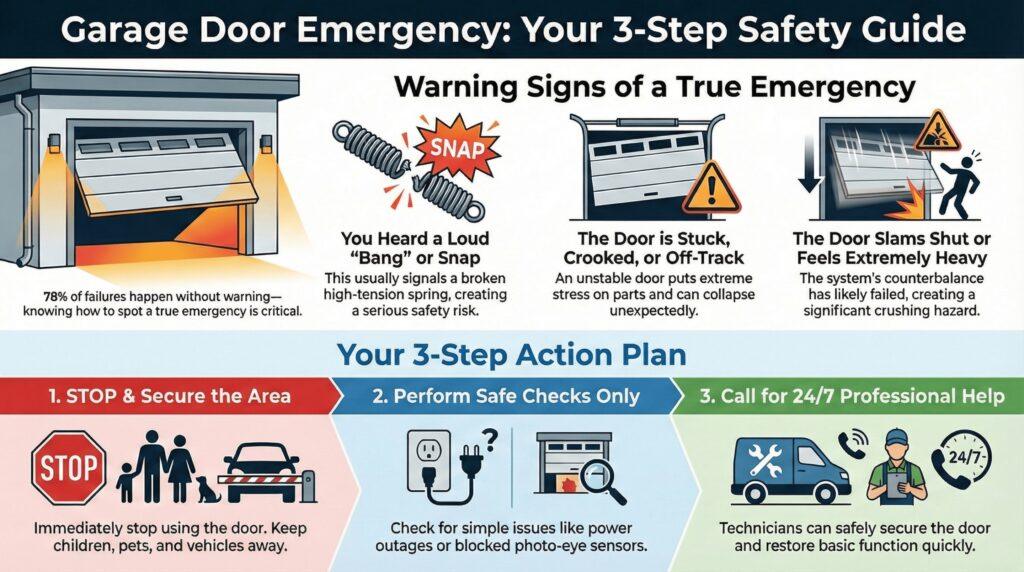
Given that an estimated 78% of residential entry system failures happen without warning, it’s no surprise that many emergencies come as a shock.
The Garage Door Won’t Open or Close at All
When your garage door simply refuses to move, it’s a sign that critical components like the opener motor, logic board, or drive system have failed. If your door won’t respond, it could leave your car trapped inside or compromise your home’s security.
Pushing harder or repeatedly pressing the button won’t help; it can strain the motor or wear down internal parts faster.
The Door Is Stuck Partially Open or Crooked
Halfway positions, where the door stops unevenly, are not a “pause” in the system; they’re a warning. When a door hangs off-balance, it places uneven stress on springs, cables, and tracks.
Over time, that stress accelerates wear, increases the chance of a snapped cable, and makes the door unsafe for continued use. Apart from mechanical strain, a door left partially open also leaves your home vulnerable to weather, pests, and opportunistic intruders.
You Heard a Loud Bang or Snap
That abrupt, gunshot-like sound is unlikely to be caused by a loose screw or a minor glitch. In most cases, a loud bang means a torsion or extension spring, designed to balance the door’s weight, has failed.
These springs operate under extreme tension, and when they break, the door loses its counterbalance instantly. At that point, trying to manage the door is a serious safety risk.
According to safety data, thousands of people are injured by garage door failures each year, often because homeowners underestimate the force a garage door can exert.
The Door Feels Extremely Heavy or Slams Shut
A garage door should feel smooth and balanced. If it suddenly feels heavy, jerky, or slams down instead of lowering gently, it means the counterbalance system, typically springs, is not doing its part.
This creates a serious hazard: a door that’s too heavy for the opener can slip, fall unexpectedly, or crush objects (or body parts) in its path.
NEISS estimates compiled from the U.S. CPSC’s injury database indicate that each year, thousands of Americans are treated in emergency departments for garage door-related injuries, including entrapment, crush, and pinch incidents. (Source: U.S. Consumer Product Safety Commission – NEISS injury data)
The Opener Runs, but the Door Doesn’t Move
When you hear whirring or humming from the opener but the door doesn’t budge, something has lost its link: the trolley, chain, belt, or drive gears may be failing or out of sync.
Repeated button presses in this condition usually won’t help and can actually quicken the wear on the opener’s motor.
The Door Has Come Off Its Tracks
A door off its tracks looks dramatic, and for good reason. Tracks guide the door up and down smoothly; when they’re bent, misaligned, or broken, the entire system can jam, bind, or collapse.
What often starts as a small dent or shifting bracket quickly becomes a significant safety risk, particularly if the door binds mid-cycle.
Even a slight misalignment can disrupt the door’s balance, leading to further issues if left unattended.
Emergency vs. Non-Emergency Garage Door Problems
The key difference between an emergency garage door service and a routine repair comes down to safety, stability, and access.
Emergency issues are the ones that:
-
Prevent the door from moving safely
-
Leave the door partially open or unstable
-
Create a risk of injury, sudden failure, or forced entry
Non-emergency problems may feel inconvenient, but the door still functions and doesn’t pose immediate danger. These can usually be scheduled during regular service hours without additional risk.
|
Issue or Symptom
|
Emergency Garage Door Problem
|
Non-Emergency Garage Door Problem
|
Recommended Response Time
|
|---|---|---|---|
|
Door movement
|
The door won’t open or close at all
|
The door moves slowly or unevenly, but still operates
|
Emergency: Immediate
Non-emergency: Schedule service |
|
Door position
|
Door stuck halfway, crooked, or off-track
|
The door closes fully, but makes a noise
|
Emergency: Immediate
|
|
Noises
|
Loud bang, snap, or grinding sound
|
Mild squeaking or rattling
|
Emergency: Immediate
|
|
Door weight
|
The door feels extremely heavy or slams shut
|
The door feels normal but lacks smoothness
|
Emergency: Immediate
|
|
Opener behavior
|
The opener runs, but the door does not move
|
Remote works inconsistently
|
Emergency: Immediate
|
|
Safety risk
|
Risk of the door falling, injury, or forced entry
|
No immediate safety concern
|
Emergency: Same day
|
|
Security impact
|
Garage is left open or cannot be secured
|
Door locks, but performance is reduced
|
Emergency: Immediate
|
|
Structural strain
|
Springs, cables, or tracks under visible stress
|
General wear on rollers or hinges
|
Emergency: Immediate
|
What Emergency Garage Door Service Typically Includes
When homeowners call for emergency garage door service, they are rarely looking for a full upgrade or long-term improvement. What they need, right then, is stability, safety, and a door that works again without creating more problems.
The first priority is making the situation safe. If your door is stuck halfway, off-track, or suddenly heavy, it can move unexpectedly.
Technicians focus on securing the door, relieving strain on the system, and preventing sudden drops or shifts that could cause injury or damage. This often means stabilizing the door before any repair work begins.
Next comes finding the root of the failure. Emergency calls usually involve something that failed suddenly, such as a spring breaking, a cable slipping, or an opener disconnecting from the door.
The goal is to identify what went wrong and address the immediate cause so the door can operate safely again.
Emergency service also focuses on restoring basic function and access. That may mean fully closing and securing the door, reconnecting the opener, or allowing the door to open smoothly enough for a vehicle to enter or exit.
In many cases, this resolves the crisis entirely. In others, it stabilizes the door and clearly outlines what follow-up repairs should be scheduled.
Get Emergency Garage Door Service Fast With Stewart Overhead Door Co. Ltd.
When a garage door starts behaving unpredictably, winter weather or not, the real question is simple: Is it still safe to use? If the door is stuck, crooked, unusually heavy, or making sudden bang-and-stop noises, the risk isn’t only inconvenience.
It’s the door’s weight, the strain on the system, and the possibility of losing secure access to your home. In those moments, the safest decision is often to stop “testing it one more time” and treat it like the heavy moving equipment it is.
A practical takeaway is this: emergencies are rarely about “a part broke.” They’re about a door that can’t move safely or can’t be secured. When you respond early, before the door slips off track, the opener burns out, or a panel gets bent, you usually keep the repair simpler, faster, and safer.
What to do next
-
Stop using the door if it’s heavy, crooked, stuck, or noisy. If anything looks misaligned or the door won’t move normally, don’t force it. Secure the area, keep kids and pets away, and use an alternate entry if possible.
-
Do only the low-risk checks, then pause. You can check for obvious issues like a power outage, a tripped breaker/GFCI, or blocked photo-eyes. If the door still won’t move cleanly, stop; repeated attempts can worsen the damage.
-
Call Stewart Overhead Door Co. Ltd. for emergency help and a safety-first fix. Stewart Overhead Door Co. Ltd. has been serving southwestern Ontario since 1964 with certified technicians and a 24/7 emergency response for residential, commercial, and agricultural doors. We focus on stabilizing the situation, restoring safe function, and keeping your property secure.
If your garage door feels unsafe or unusable right now, contact Stewart Overhead Door Co. Ltd. for 24/7 emergency service and get your door back to safe, reliable operation.
FAQs